Website Development Design: How Modern Sites Are Planned, Built, and Grown in the United States
Every business website you visit in 2026 exists at the intersection of creative vision and technical execution. Website development design is the discipline that brings those two forces together-planning how a site looks, how it works, and how it grows over time. Whether you run a local service company in Texas or a scaling startup in New York, getting this right is what separates sites that convert from sites that collect dust.
Key Takeaways
- Website design and web development are distinct phases in creating a website, but they must work in lockstep. A 2026 small business site needs UX design for intuitive navigation, search engine optimization for visibility, and fast, secure hosting to keep visitors engaged. EZPages.Pro handles all three under one roof.
- The key differences between web design and web development come down to focus: design centers on visual aesthetics and user experience, while development involves coding with programming languages like Hypertext Markup Language (HTML), Cascading Style Sheets (CSS), and JavaScript to ensure website functionality.
- Responsive web design and compliance with the Web Content Accessibility Guidelines (WCAG) are non-negotiable for U.S. businesses. With 401 ADA web accessibility lawsuits filed in July 2026 alone, legal risk is real-and Google increasingly factors mobile usability and accessibility into rankings.
- EZPages.Pro manages the full design process, from strategy and wireframes to launch and ongoing management, often delivering small sites in 5–14 days using proven Duda templates as a top website builder for small businesses.
- Artificial intelligence and progressive web apps are reshaping how sites are built and experienced. EZPages.Pro leverages AI-assisted tools and modern web capabilities on the Duda platform to accelerate builds without sacrificing quality.
What Is Website Development Design?
Website development design is the combined planning and execution of UX/UI design, technical architecture, content strategy, and code to produce functional websites that achieve specific business goals. It covers everything from choosing a color palette and mapping user flows to selecting a hosting platform and writing server side logic.
Design elements like typography, layout design, and imagery influence development decisions such as image optimization formats and page weight. Meanwhile, development choices-frameworks, databases, hosting-shape what's visually possible. Website development transforms design into a functioning website through coding, meaning the two disciplines must be planned together from day one.
Consider a local law firm in Texas launching a new website in 2026. It needs clear navigation (Home, Practice Areas, Attorneys, Contact), readable fonts for older demographics, trust signals like client testimonials, local SEO schema markup, and load times under two seconds on mobile devices. Understanding your audience improves website design effectiveness, and every one of those requirements shapes both design and development choices simultaneously.
EZPages.Pro specializes in this full-spectrum approach, handling design and development on top of Duda's infrastructure so clients get strategy, build, hosting, security, and SEO in a single engagement.
Web Design vs. Web Development: Key Differences and Overlap
Website design and development refer to distinct phases in creating a website, but the line between them is blurrier than ever. Web design focuses on visual aesthetics and user experience-the look, feel, and flow a visitor encounters. Web development involves coding to ensure website functionality-the structure, data, and integrations that make everything actually work.
In practice, web designers focus on user interface design, website layout, imagery, and visual appeal. They use tools like Figma, Photoshop, and Sketch to create wireframes and high-fidelity mockups. Web developers primarily use HTML, CSS, and JavaScript for coding, plus server-side languages and database systems to handle logic and data. Design outputs include mockups and prototypes; development outputs include codebases that power live web pages.
Design and development require distinct tools and skill sets. Design focuses on aesthetics while development emphasizes functionality. Web designers typically do not code complex functionalities, and web development is often more expensive than web design services because of the engineering depth required. Yet modern projects blur the lines: designers need enough HTML and CSS knowledge to ensure their layouts are buildable, and web developers need to care about UX flows and micro-interactions like hover states and transitions.
A successful website requires collaboration between design and development. At EZPages.Pro, that collaboration starts on the first strategy call. Designers and developers share a brief, align on scope, and work through parallel checkpoints-wireframe review, visual design approval, then development-so nothing falls through the cracks.
Core Design Elements of a High-Converting Website
The design elements that drive conversions aren't decorative-they're strategic. Layout, visual hierarchy, color theory, typography, imagery, and white space all work together to guide visitors toward action. Website design should prioritize a clear visual hierarchy and usability so that every page earns its keep, supported by essential website features every business needs to convert visitors into customers.
Visual hierarchy guides users from headline to subheadline to call-to-action in a deliberate visual flow. On a 2026 U.S. e-commerce product page, for example, the product image should be large and crisp, the price and "Add to Cart" button prominent near the top, trust badges and ratings visible, and the description below. User Interface (UI) encompasses visual elements like buttons and layout, and each of those graphical elements must earn attention in the right order.
Typography affects readability and complements a website's aesthetic style-larger font sizes and generous line height keep mobile readers engaged. Visual balance in web design ensures equal visual weight on both sides of a layout, preventing the page from feeling lopsided. Web design combines aesthetics and functionality for user engagement, and design must balance aesthetics with usability to avoid confusing users.
Consistent branding-logo placement, color palette, button styles-builds trust across every page. EZPages.Pro uses brand style guides and reusable design systems on Duda to keep visual design unified and easy to maintain, even as new web pages are added over time.
UX Design and Interactive Design: Making Sites Easy and Enjoyable to Use
UX design is the overall experience a visitor has on your site: how easily they find information, how logically pages connect, and how satisfying the journey feels. Interactive design is the layer on top-how users physically engage with menus, forms, buttons, and animated graphics. Good web design considers user experience and interface design as inseparable partners.
User Experience (UX) involves researching user behavior and structuring navigation based on what real visitors need. For U.S. audiences in 2026, that means clear navigation labels ("About Us," not "Who We Are"), predictable page layouts, and strong above-the-fold messaging so visitors immediately know what the business does. User experience design considers layout, instructions, and labeling, and it focuses on how a site feels to users-not just how it looks.
Intuitive navigation enhances user experience on a website, and using clear visual cues improves user navigation and interaction understanding. Small interactive touches-hover states on buttons, inline form validation messages, subtle scroll effects-improve usability without slowing the site down. UX design improves user interactions and overall satisfaction, effective UX design can increase user retention and engagement, and a well-designed UX can lead to higher conversion rates.
Testing with real users is vital to identify usability issues and improvements. EZPages.Pro prototypes key user flows-contact forms, booking sequences, checkout-before development begins, ensuring the web experience is smooth before a single line of production code is written.

Responsive Web Design for Every Device
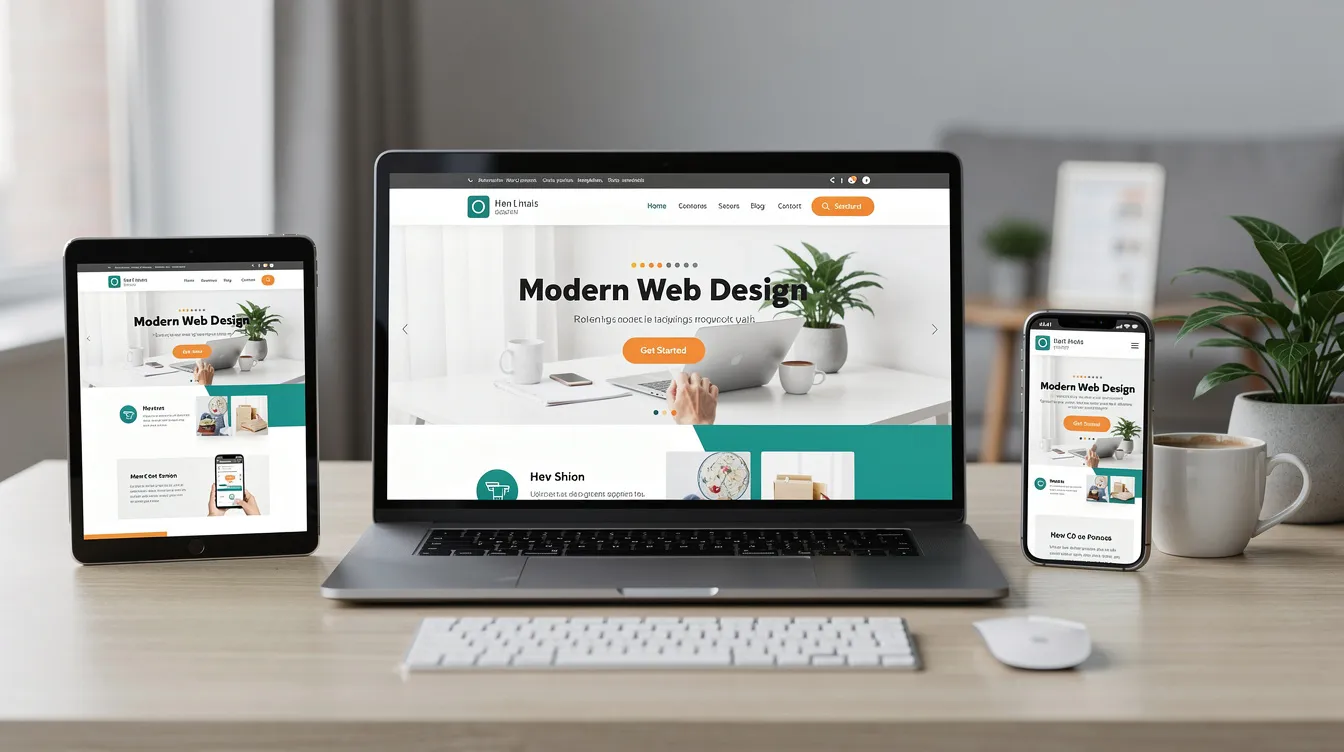
Responsive web design adjusts to different screen sizes automatically, ensuring your site looks sharp on a phone in someone's hand and on a 27-inch monitor in an office. In March 2018, Google announced mobile-first indexing, making mobile UX a direct ranking factor. A mobile-first approach ensures usability on various devices, and if your site isn't built responsively in 2026, you're losing both visitors and search engine visibility.
Responsive web design uses CSS3 for flexible layouts. It uses flexible layouts and media queries for adaptation, allowing grids, images, and content blocks to reflow based on viewport width. Responsive design improves user experience across devices and simplifies maintenance by eliminating separate mobile and desktop versions of your site.
Adaptive design, by contrast, serves distinct layouts built for specific breakpoints-a dedicated mobile version, a tablet version, and so on. While adaptive can deliver tailored experiences, responsive design is more flexible, less expensive to maintain, and the standard for most U.S. small business sites.
EZPages.Pro builds every site as responsive by default on the Duda platform, offering many businesses a better alternative to WordPress for business websites. Pages are tested across common U.S. devices-iPhone, Android phones, iPad, and standard laptop resolutions-during both the design and QA phases.
The Website Design Process: From Strategy to Launch
The web design process follows a clear sequence, and skipping steps almost always leads to rework. Here's how EZPages.Pro structures the design process for U.S. clients:
- Discovery: Stakeholder interviews, business goal identification, audience personas, and competitor analysis. Mapping content helps optimize user experience and SEO from the start.
- Strategy and information architecture: Sitemap creation, value propositions, and defining the target audience for every page.
- Wireframes and prototypes: Low-fidelity layout mockups and clickable prototypes that let clients test navigation before visual design begins. Designers create wireframes to validate structure before investing in polish.
- Visual UI design: Applying branding-colors, typography, imagery-into high-fidelity design comps that represent the final look.
- Content creation and migration: Copywriting, image sourcing, SEO metadata, and alt text for every visual asset.
- Development: Front end web development translates the approved design into live code. Back-end integrations, hosting configuration, and performance tuning happen in parallel.
- Testing and QA: Cross-device and web browsers testing, performance audits, accessibility checks, and functional tests on forms and integrations.
- Launch: Domain pointing, go-live, and monitoring.
Realistic timelines for U.S. small businesses: 5–7 days for a brochure site using website templates, 2–4 weeks for custom multi-page builds, and 4–8+ weeks for complex web applications with deep integrations. The U.S. industry average sits at 8–12 weeks for mid-sized projects-EZPages.Pro consistently beats that by using standardized processes and affordable website plans for startups and small businesses on Duda's efficient build environment.
Collaboration checkpoints after strategy, wireframes, and visual design ensure clients approve direction before development proceeds, eliminating costly surprises.
Technical Skills and Programming Languages Behind Modern Websites
Even visually appealing projects rely on solid technical skills and well-chosen programming languages under the hood. A particular website might look simple on the surface, but its website's code determines whether it loads fast, scales smoothly, and integrates with third-party tools.
HTML, CSS, and JavaScript are essential coding languages for web design. Front-end development involves translating design into HTML, CSS, and JavaScript-HTML (Hypertext Markup Language) provides content structure with semantic HTML tags, CSS handles styling and responsive layouts, and JavaScript powers interactivity. Back-end development includes managing databases and server side logic, often using Node.js, Python, or platform-specific engines. Among U.S. sites, over 33 million use Intersection Observer and over 16 million use React, illustrating how deeply JavaScript libraries are embedded in the modern web.
Content management systems simplify website updates and management, and WYSIWYG editors allow users to build websites without coding. Platforms like Duda, which powers EZPages.Pro sites, abstract most raw code behind visual editors while still enabling custom widgets and integrations when needed. Clients don't need to write code-they can update web content through an intuitive dashboard.
If you're a non-technical U.S. business owner, EZPages.Pro handles all complex implementation so you can focus on content and strategy, and you can follow smart steps small businesses can take to boost website success without touching code. Need to update a heading or swap an image? The CMS makes it easy. Need a custom booking widget or chat integration? EZPages.Pro's development team builds it.

Performance, Security, and SEO: The Functional Side of Design
Performance, security, and search engine optimization must be considered from the very first wireframe, because design decisions directly affect a site's performance. Website performance should aim for fast loading times and responsiveness. Optimizing page load speed is essential for user satisfaction and SEO-Google's core web vitals (Largest Contentful Paint, First Input Delay, Cumulative Layout Shift) are both ranking signals and user satisfaction metrics.
Image optimization, clean code, and caching dramatically improve speed. A U.S. services company that redesigned its site and improved load time from five seconds to under two saw bounce rate drop by over 30%. That kind of improvement comes from choosing efficient image formats like WebP, lazy loading below-the-fold content, and minimizing third-party scripts that bloat page weight.
Security is equally critical. Essential practices for U.S. sites in 2026 include HTTPS everywhere, regular backups, automatic platform updates, and protection against common exploits like XSS and SQL injection. Privacy compliance-SSL, CCPA data policies, GDPR for U.S.–EU traffic-adds another layer, all of which are clarified in the EZPages.Pro website disclaimer.
EZPages.Pro's managed hosting on Duda includes enterprise-grade security, uptime monitoring, automatic backups, and on-page SEO features like meta tags, schema markup, and mobile-first architecture. Clients get technical SEO baked in without needing to hire a separate vendor.
Accessibility and Compliance in U.S. Website Design
The ADA (Americans with Disabilities Act) and WCAG (Web Content Accessibility Guidelines) set the standard for digital accessibility in the United States. WCAG compliance is crucial for website accessibility and inclusivity, and with hundreds of lawsuits filed monthly-401 in July 2026 alone-the legal risk for non-compliant sites is substantial. Accessibility standards guide the design and development process to cater to all users.
Core accessibility practices include:
- Sufficient color contrast (at least 4.5:1 for body text) improves readability for visually impaired users
- Descriptive alt text helps screen reader users understand images
- Keyboard navigability ensures all functions are accessible without a mouse
- Semantic headings (H1, H2, H3) and proper form labels support assistive technology
- Skip navigation links and ARIA attributes where needed
Accessibility in web design benefits all users, not just those with disabilities. Clear contrast, logical tab order, and descriptive labels make every site easier to use, and understanding web accessibility laws and requirements helps U.S. businesses align design decisions with legal expectations.
Consider a New York restaurant in 2026 needing an accessible online menu and reservation form. Dish images need alt text, menu markup must be parseable by screen readers, the reservation form needs proper labels and keyboard access, and directions must be accessible-all functional elements that serve every customer.
Regular accessibility testing identifies barriers for users with disabilities. EZPages.Pro bakes accessibility checks into every build and conducts audits as part of ongoing site management, helping U.S. businesses reduce their legal exposure while serving every visitor well.
Progressive Web Apps and Modern Web Experiences
Progressive web apps (PWAs) are websites that behave like mobile apps-offering offline support through service workers, installable home screen icons, and push notifications. The PWA market is projected to grow strongly through 2033, driven by high mobile penetration and demand for app-like experiences delivered through web browsers.
PWA features make sense for businesses with frequent returning users-content publishers, membership sites, e-commerce stores with repeat customers-or where poor connectivity is common. Full native apps still win when deep device hardware access or App Store presence is essential. Progressive enhancement prioritizes content accessibility for all users, meaning the base experience should work everywhere before layering advanced capabilities.
Good UX design, fast performance, and secure HTTPS are prerequisites before adding PWA capabilities. A PWA layered on a slow, insecure site adds little value.
EZPages.Pro advises U.S. clients on when a PWA or advanced web app approach is worth the investment versus a high-performing marketing site. For most small businesses, a fast, responsive, SEO-optimized site delivers more ROI than a full PWA build-but when the fit is right, the team can implement those features.
Artificial Intelligence in Website Design and Development
Artificial intelligence is reshaping the web design industry in 2026. AI tools now assist with copy generation, image creation, UX personalization based on user behavior, predictive heatmaps, and customer support chatbots. Platforms are investing heavily in AI-native features to reduce technical debt and accelerate collaboration between designers and developers.
Practical examples for U.S. business sites include AI-drafted headlines and content outlines, auto-suggested image themes, chat widgets that answer FAQs using natural language, and homepage personalization based on visitor location or device type. Animation tools and design assistance powered by AI help teams move faster from concept to prototype.
But AI demands oversight. Brand voice needs human editing. Legal compliance-copyright, accessibility, accuracy-requires expert review. Overuse of AI can make a web experience feel generic and robotic. The tech industry is learning that AI is a force multiplier, not a replacement for skilled web designers and web developers.
EZPages.Pro selectively integrates AI tools-AI chat widgets, smart search, content suggestions-while maintaining expert human design, copywriting, and QA. Every AI-generated element passes through human review before going live.
Ongoing Website Maintenance and Optimization
Websites built in 2024–2026 cannot be "set and forget." Search engine algorithms evolve, security threats grow more sophisticated, and user expectations shift. A site that performed well at launch can fall behind within months without active management.
Monthly maintenance tasks include:
- Backups and platform updates
- Security scans and vulnerability patching
- Content refreshes (copy, images, blog posts)
- Performance audits and core web vitals monitoring
- A/B tests on calls-to-action and page layouts
- UX tweaks based on analytics and user behavior data
Here's a real scenario: a U.S. SaaS company's blog drives strong traffic, but the contact page has a high exit rate. After quarterly UX and SEO optimization-moving the contact form higher, simplifying form fields, strengthening the CTA copy-conversion rate climbs 25%. That kind of improvement only happens with ongoing attention.
EZPages.Pro's all-in-one management covers hosting, updates, content edits, security, and analytics reports. Clients choose a maintenance plan, offload the technical side, and get regular reports showing measurable improvements in their site's performance by leveraging a professional website management service.
How EZPages.Pro Supports U.S. Agencies with White-Label Design and Development
White-label services let agencies sell professional websites under their own brand without building them in-house. EZPages.Pro builds and maintains Duda websites that partner agencies resell as their own, handling the technical heavy lifting behind the scenes.
Specific offerings include site creation from scratch, template customization, widget configuration, page design, bulk page editing for campaigns, and ongoing SEO and compliance support. This helps U.S. marketing and creative agencies scale across multiple projects and multiple states without hiring full in-house development teams.
Collaboration workflows are structured: shared project briefs, defined SLAs, and consistent design systems ensure every white-label site meets performance, security, and accessibility standards. Agencies maintain brand consistency with their clients while EZPages.Pro delivers creating websites at speed and quality that would be difficult to match internally.
Ready to Build a Website That Actually Works? Let EZPages.Pro Handle It
If you're a U.S. small business owner tired of juggling separate designers, developers, hosting providers, and SEO vendors-or an agency looking to scale without the overhead-EZPages.Pro is built for you.
You get responsive web design, secure managed hosting, ADA/WCAG compliance, on-page SEO, and launch windows as fast as 5–14 days, all under one roof with transparent pricing—exactly what defines the best websites for small companies. EZPages.Pro serves clients in 14+ countries but is deeply familiar with U.S. regulations-ADA, CCPA, GDPR for transatlantic data-and local SEO needs that help your own website rank where it matters.
Schedule a free strategy call today. Whether you need a visually appealing business website from a proven Duda template or a fully custom build, EZPages.Pro will scope it, design it, develop it, and keep it running-so you can focus on running your business.
Frequently Asked Questions About Website Development Design for U.S. Businesses
How long does it take to design and develop a professional website with EZPages.Pro?
For smaller brochure sites using proven Duda website templates, EZPages.Pro typically delivers in 5–7 days. More custom multi-page builds take 2–4 weeks, depending on content readiness and the number of unique page layouts. These timelines are significantly shorter than the U.S. industry average of 8–12 weeks because EZPages.Pro uses standardized processes and Duda's efficient platform.
Complex web applications or custom integrations-booking engines, membership portals, API connections-may require longer schedules. Those timelines are scoped during an initial strategy call so there are no surprises.
Do I need to know how to code to work with EZPages.Pro?
No coding knowledge is required. EZPages.Pro handles all technical implementation, programming, and configuration. You focus on your business goals and content; the team handles everything from graphic design to server side deployment.
If you prefer a bit of DIY control, you can make simple content edits-text changes, image swaps-through an intuitive visual editor. EZPages.Pro provides training walkthroughs so your U.S. team can update web content confidently without risking the website layout or breaking any functional elements.
How much does a professionally designed website typically cost in the United States?
In 2026, costs range widely. DIY website builder plans start under $30/month but often come with limitations in visual aesthetics, performance, and compliance. Typical agency projects run $5,000–$15,000+ depending on complexity, page count, and custom functionality.
EZPages.Pro offers transparent, flat-rate packages starting at $59/month-well below typical full-service agency price tags-while including design, development, hosting, and maintenance. Exact pricing depends on scope, and the team provides no-obligation quotes after a brief discovery conversation.
Can EZPages.Pro help with SEO and compliance (ADA, GDPR, CCPA) for my U.S. website?
Yes. EZPages.Pro focuses on on-page and technical search engine optimization: site structure, metadata, schema markup, performance optimization, and mobile-first design. Every build is designed with accessibility in mind and can be aligned with ADA/WCAG guidelines to reduce legal risk-critical given the volume of accessibility lawsuits in the U.S.
The team also configures cookie banners, privacy pages, and data-handling basics that support GDPR and CCPA compliance. For deeper accessibility needs, EZPages.Pro integrates tools like UserWay alongside manual compliance checks.
What happens after my site launches with EZPages.Pro?
Post-launch, EZPages.Pro provides uptime monitoring, security patching, backups, small content updates, and periodic performance and SEO reviews. Clients choose ongoing management plans so they never have to worry about platform updates, security vulnerabilities, or site's performance degradation.
Analytics integration with Google Analytics and Search Console comes standard. EZPages.Pro reviews key metrics with clients on a regular cadence, guiding continuous improvements based on real data rather than guesswork. The goal is a site that gets better every month, not one that slowly decays after launch day.

EzPages.Pro specializes in small business web management and web development for small businesses and startups. Our tailored solutions simplify content updates, track performance with analytics, and ensure smooth site operation. With our all-in-one management services, you can focus on growing your business while we handle the rest.
🚀 Let’s build something great together.
EZPages blog